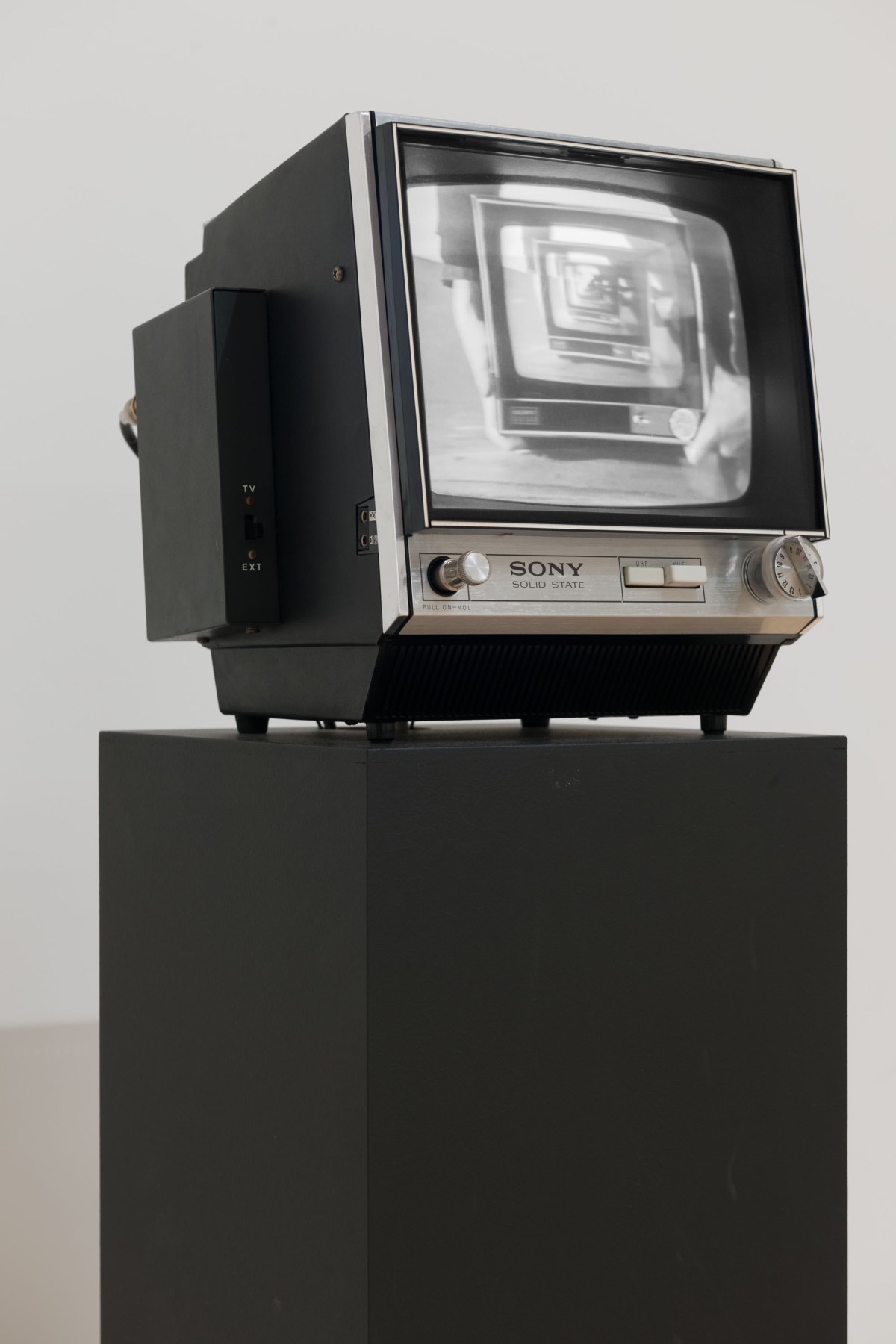

Monitor, 1974-1996, – video installation version installed at TATE Britain 2014.
In 1996 two original videotape works (Monitor and Easy Piece), were re-envisaged as installations using the original apparatus to help to context the works closer to their period. This was especially resonant for Monitor, which was acquired in this form by TATE in December 2014 for its permanent collection. It was then selected for the re-hang at TATE Britain entitled BP Walk through British Art – 500 Years of British Art, TATE Britain, January 2015- December 2017 (pictured above). The TATE label stated that:
Monitor is one of the early defining works of video art in Britain, revealing the structural possibilities the medium offered to artists. For Partridge it is a pure exploration of its working process. A 1973 Sony monitor is recorded close up by a camera, the hardware becoming the subject of the video. The camera, linked to the monitor it is filming, creates in the monitor an infinite succession of repeated images of itself. The artist’s hands are seen to turn the monitor to the right through 90 degrees, challenging the physical restrictions of the monitor by becoming physically involved with repositioning it. (TATE Gallery label, September 2016)
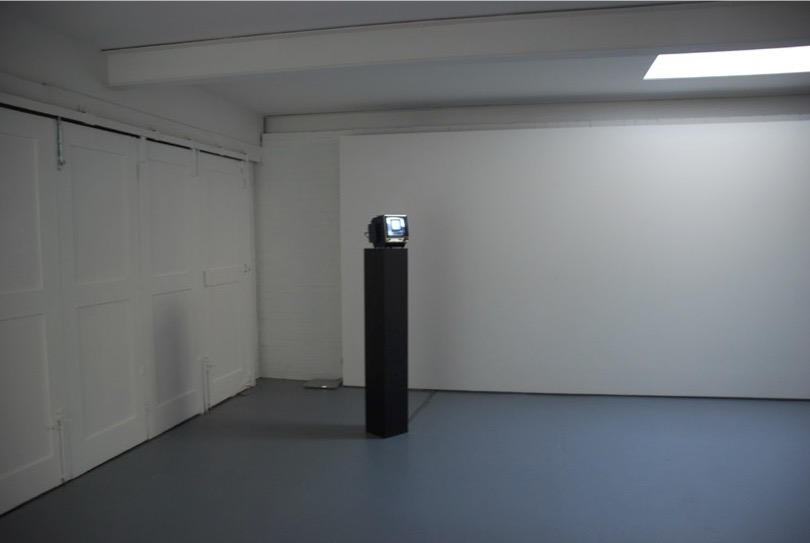
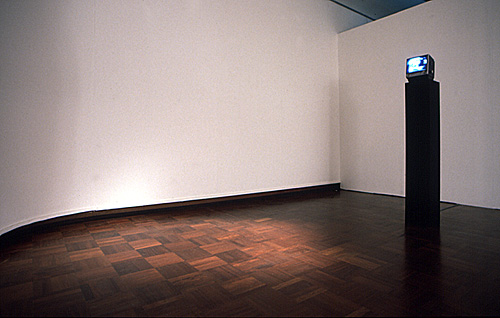
Exhibited at Media Circus – research show of the School of Television & Imaging, DJCAD, Dundee, 1996. The Showroom, London, 1997; Cooper Gallery, DJCAD, Dundee, March 1999; Peacock Gallery, Aberdeen 2000; Experiments in the Moving Image, Old Lumiere Cinema, London, 2004; Artists’ Video in the 70s & 80s, doggerfisher gallery, Edinburgh, 2008; British Artists’ Video in the 1970s and 1980s, Dundee Contemporary Arts, November 2012; REWIND| British Artists’ Video, Careof, DOCVA, Milan, Italy, 6 November- 20 December 2012; CURRENT: Contemporary Art from Scotland, Shanghai Minsheng Art Museum, China, 17th December 2016 – 15th January 2017; Laboratory of Presentation Techniques, Arton Foundation, Warsaw, March – April 2021; Modern Conversations, Tate St Ives, May 2021-25; About The Future at Palazzo GIL, Campobasso, Molise Culture Foundation. Produced and organized by Luca Basilico, 17 to 27 November 2022.

Installed in doggerfisher Gallery Edinburgh 2006

We can see in both Jonas’ and Partridge’s works that the loss of control and unpredictability which they bring in through invisible montage (manipulation of time) work against the notion of real time simultaneity. There is, however, a tension in Jonas’ work between the figure of Honey being subjugated to the electronic medium and the spoon she is banging in time to the roll. Still, the vertical roll of the monitor continuously erases her figure in electronic waves. As has been remarked upon by many, the vertical hold function on the monitor can be seen to mirror the movement of celluloid film through a projector. Indeed, the video is a highly constructed montage of temporalities and body positions even though it appears to be continuous.
In Monitor, Partridge makes a video about video itself by turning the camera in on itself and pointing it at the monitor to create the phenomenon of feedback, which John Calcutt has noted resembles “an infinite series of repeated images, each nestled within the other like Chinese Boxes.” As the video unfolds, repetition seems to come unhinged as we “see that the effect of feedback has actually been ‘faked.’” Monitor sets up the illusion of a feedback image that begins to lose synch with each successive frame within the frame. Partridge has deconstructed and reconstituted the content of each image, which no longer mirrors the previous image but creates a dynamic and unpredictable kaleidoscope. Through carefully concealed montage, each frame takes on a rhythm and a frame of its own.
Real Time Zidane Zidane en temps réel, Janine Marchessault, article from the journal Cinémas Volume 28, Number 2-3, Spring 2018, p. 71–91 Mutations du montage : esthétiques, technologies, pratiques et discours
updated February 19 2025
 Professor Stephen Partridge